
Blepharoplasty is a cosmetic surgical procedure that addresses excess skin and puffiness on the upper or lower eyelids. Suitability and approach are assessed individually at consultation, and outcomes vary between patients.
Share your details and our team will be in touch within one business day.

It’s natural to notice changes around the eyes as we age. Over time, the upper and lower eyelids may develop puffiness, skin laxity, or discolouration due to ageing, environmental exposure, or genetics. In some cases, excess skin around the eyes can also interfere with vision.
Blepharoplasty, also called eyelid surgery, is a procedure designed to remove excess skin and fat from the upper or lower eyelids to address these concerns. To find out whether it may be suitable for you, book a consultation at My Cosmetic Clinic to discuss your options with a qualified medical practitioner.

Blepharoplasty, or eyelid surgery, is a facial cosmetic surgery that aims to remove or reposition excess skin and fat tissue around the eyes. Options are available for both the upper and lower eyelids.
Depending on your case, eyelid surgery may involve:
We assess suitability and approach individually at consultation, and outcomes vary by patient.
The best candidates for blepharoplasty (eyelid surgery) are people who are:
The best way to determine if you are suitable for this procedure is to consult an experienced cosmetic practitioner at My Cosmetic Clinic, who may assess your individual needs and expectations.
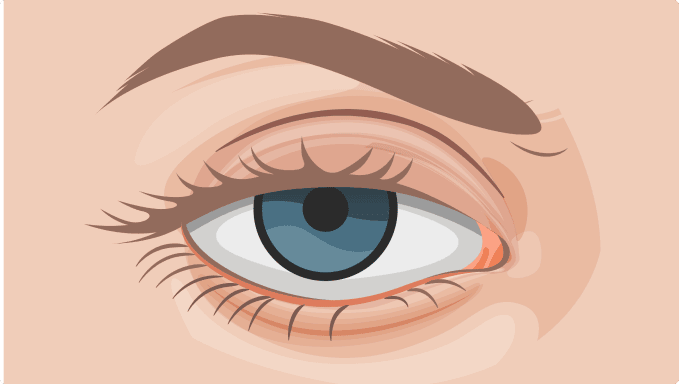
Several surgical procedures and techniques are available for eyelid surgery. The right approach depends on your anatomy and what you’re addressing, and your practitioner will walk you through the options at your consultation.
Bladeless blepharoplasty uses an energy-based device rather than a scalpel to create the incision designed to adjust drooping eyelid skin.
This technique uses very small incisions. Compared with traditional methods, it may involve less bleeding, bruising, and swelling, though recovery varies between patients.
An upper blepharoplasty in Sydney is performed by making an incision in the natural fold of the upper eyelids. The excess upper eyelid skin and fat is removed from the upper lid, and eyelid muscles may be tightened.
The upper eyelid blepharoplasty is performed using local anaesthesia, though patients may choose to be slightly sedated.
A lower blepharoplasty in Sydney on the lower eyelids typically involves an incision below the lower lash line or just inside the lower lids. The technique intends to remove excess eyelid skin and fatty tissue from the lower eyelid and reposition the muscles around the eye.
To close the incision sites, you'll have either dissolvable stitches or very fine sutures. If sutures are used, these are usually removed about a week later.
Thinking about upper or lower eyelid surgery?
Talk through your options at a consultation, with no pressure to proceed.

A GP referral is required prior to consultation.

In-person consultation with a doctor, followed by a mandatory two-week cooling-off period.

Pre-operative assessment and scheduling following approval.

Procedure performed with post-operative care provided.
Consultation fees apply. A cooling-off period is required in accordance with Australian regulations.
Antibiotic ointment will be applied to your wound without bulky dressings. You may want to bring sunglasses to cover your eyes during the early recovery period.
After surgery, all patients must have a friend or relative accompany them home and, if possible, stay the night.
Bruising typically fades over two to three weeks, followed by swelling over the next three to six weeks.
Most patients begin to see results after 12 weeks. Recovery may take up to three months.
Right after a blepharoplasty, you may experience a few temporary side effects. These may include:

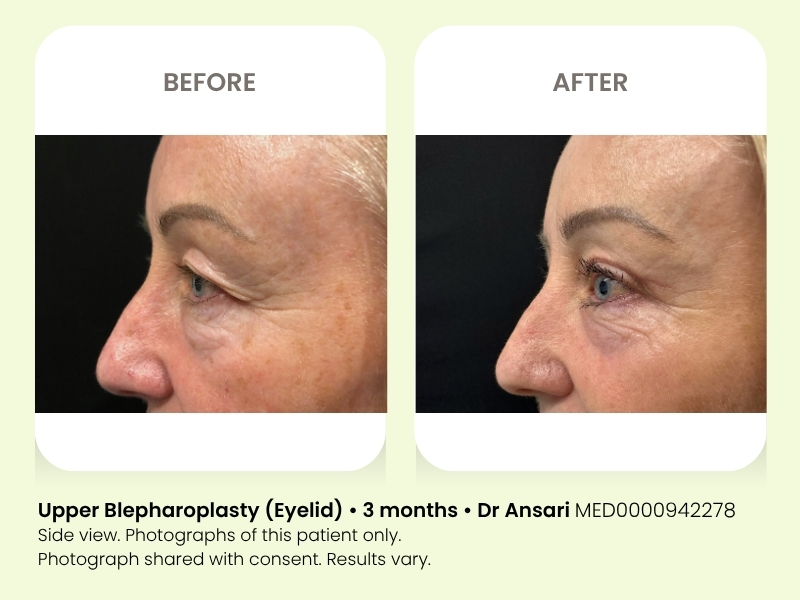
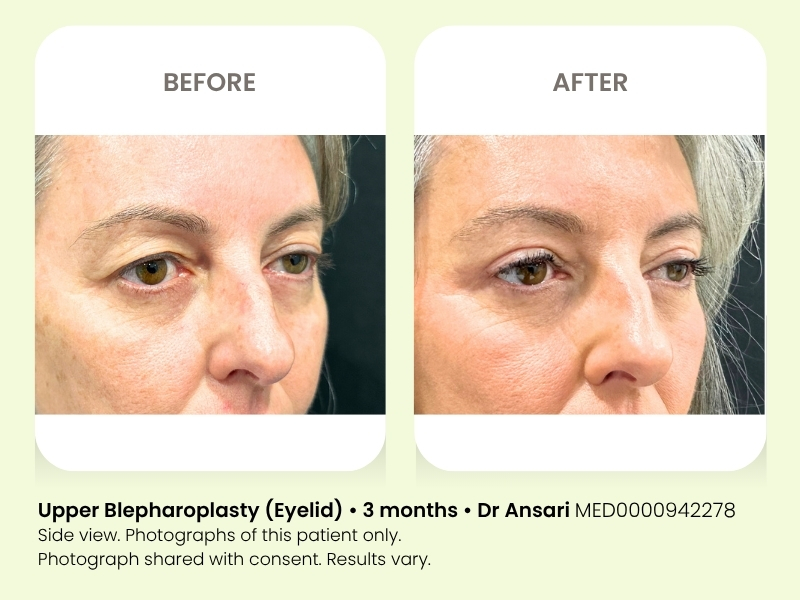
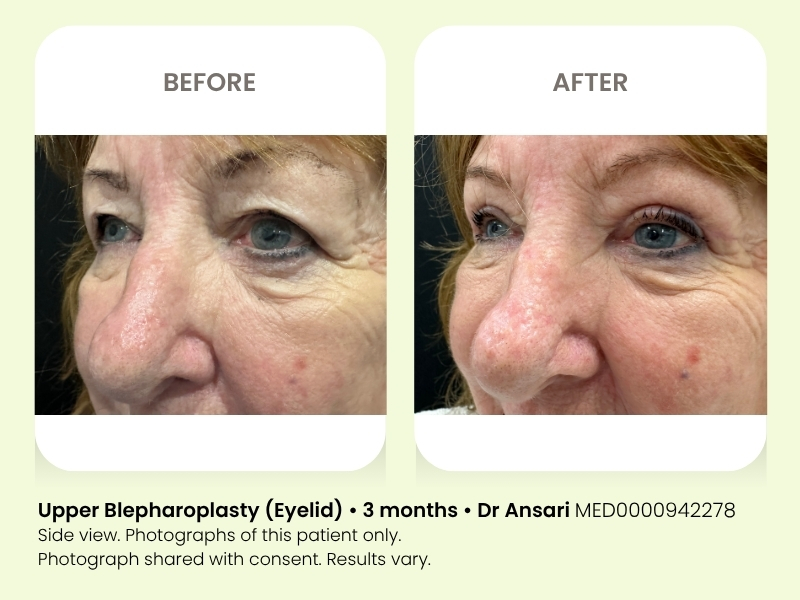
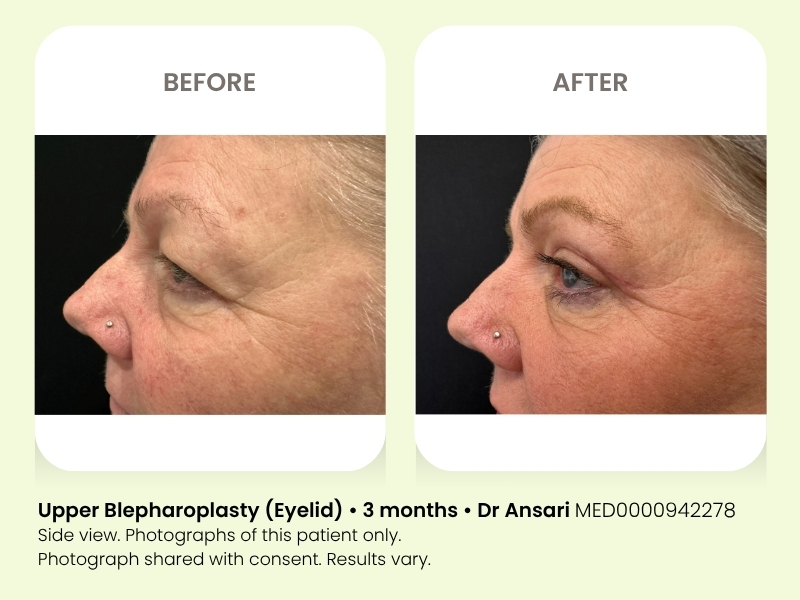
These images show one patient’s outcome following eyelid surgery. Results differ from person to person, depending on individual eyelid anatomy, the technique used and how you recover.

Dr Masood Ansari
Registered Medical Practitioner (MED0000942278)
Dr Ansari began his initial surgical training in the United Kingdom under the National Health Service and obtained membership in the Royal College of Surgeons (Edinburgh) in 2006. He then carried out extensive training in cosmetic surgery in Australia, where he was granted a fellowship from the Australasian College of Cosmetic Surgery.
Member of the Australasian Academy of Cosmetic Surgery
Bachelor of Medicine, Bachelor of Surgery
Master of Science
Member of the Royal College of Surgeons
Fellow of the Australasian College of Cosmetic Surgery
My Cosmetic Clinic is the first cosmetic clinic in Australia to be accredited against the NSQHS Standards, the national measure for patient safety.
Eyelid surgery is delicate work, and we approach it with the care it warrants, assessing each case individually and carrying it out with qualified practitioners.
We pride ourselves on putting you first with our medical-led care and focus on what we believe may be best for you.
There’s no rush to decide on eyelid surgery, and no obligation after you enquire. A consult with our team is simply a chance to ask questions, talk through whether surgery suits what you’re after, and get a clear sense of what’s involved.
Bring whatever’s on your mind. Our team can walk you through the procedure, recovery, and next steps.

Blepharoplasty may be the right procedure for you if you are affected by the aesthetic appearance of your eyelids and/or are experiencing hindrance to your peripheral vision because of your eyelids.
Some disorders would preclude you from having this surgery or require extra precautions:
With age, the upper eyelids often sag due to skin laxity, muscle weakening, and excess fat. This can lead to ‘upper eyelid hooding’, where the skin folds over the natural eyelid crease.
With age, the lower eyelids can develop puffiness, skin laxity, and under-eye hollows, related to fat displacement, reduced skin elasticity, and changes in the tissue that supports the eyelid.
The skin around the eyes is among the thinnest on the body, so changes there often show earlier than elsewhere.
For many people, skin laxity commonly begins in their 30s and becomes more noticeable in their 40s and 50s, though in some people it appears earlier because of hereditary factors.
Sagging can also relate to environmental exposure, previous surgery, trauma, or structural factors present from birth.
Yes, many people may have upper and lower eyelid surgery at the same time.
As with any surgery, blepharoplasty carries risks. Your practitioner will discuss these with you in full before you decide. They may include:
In extremely rare cases, loss of eyesight has been reported. Your practitioner will explain how these risks apply to your individual case.
Blepharoplasty is typically not painful, and you will usually feel only a slight burning sensation around your eyes for a few hours after the procedure.
Any discomfort should subside within a few hours, and the rest of your recovery period should be comfortable.
The final cost for eyelid surgery depends on your individual case, including the technique used and whether you’re combining it with another procedure.
Before anything goes ahead, you’ll receive a clear written quote so you know the full cost upfront.
Before having your blepharoplasty, we recommend:
During your initial eyelid surgery consultation, we will discuss with you:
We ask you to arrive about half an hour before your eyelid surgery, and you will be given a small dose of oral sedative at that time.
After we photograph your eye area, we will explain the surgery in detail (as we did at your consultation) and answer your questions.
Dr Ansari will take accurate measurements of the excess or loose skin to be addressed, giving you ample time to ask any remaining questions before your surgery.
Next, you will be taken to the theatre room and a small amount of local anaesthetic is used to numb the site of your surgery. This local anaesthetic is allowed to work for about 10 minutes, and then your eyelid surgery is performed.
Most patients take around a week off work to recover. Many feel ready to return to work and everyday activities within about 10 to 14 days, though recovery varies from person to person.
You won’t be able to drive after a blepharoplasty. You’ll need someone to drive you, or we can arrange a taxi if needed.
The National Safety and Quality Health Service (NSQHS) Standards are the national requirements Australian health services are measured against for patient safety and quality of care. Independent assessment, not self-assessment, awards accreditation.
Important Information
All cosmetic procedures carry risk. Outcomes vary between individuals and depend on your health, your anatomy, your skin, and how your body responds. No result can be guaranteed.
Any images shown of actual patients treated at My Cosmetic Clinic are published with consent and show the outcome for that patient only. They do not indicate the result you would experience. Any use of stock imagery is not reflective of results.
Some procedures involve prescription-only medicines. Under Australian law, these cannot be named or advertised to the public. Whether a prescription medicine is suitable for you is a decision made with a qualified health practitioner during consultation, after an assessment of your history and your goals.
Every procedure requires a consultation before treatment. During that consultation, your practitioner will explain the risks, the likely recovery, how long any effect may take to appear, how long it may last, and how often treatment may need to be repeated. You will be given time to consider your options before you decide.
Information on this website is general in nature. It is not a diagnosis, a recommendation, or a substitute for advice about your own circumstances.
Read more about the risks of the procedures we offer here: https://mycosmeticclinic.net/risks/
If you have a concern about your care, you can raise it with the clinic, with the Health Care Complaints Commission in NSW, or with Ahpra.

This website contains content which is only suitable for audiences 18+. Learn about new regulations in cosmetic surgery in this link.